Claustrophobia
2022
Claustrophobia is a mixed-media that examines the female body as a site of containment, negotiation, and resistance within sociopolitical structures. Through photography, dried plant forms, and industrial materials such as copper, bronze, and wood, the work constructs a fragmented landscape where vulnerability and authority coexist.
The body is never presented as portrait, but as fragment, cropped, faceless, reduced to surface. Skin becomes terrain: a topography marked by light, texture, and tension. By removing identity and gaze, the work resists recognition and instead positions the body as evidence of something mapped, bordered, and archived. The photographic image operates less as representation and more as documentation, implicating systems that regulate and define women’s bodies.
The dried plant elements function as quiet witnesses. No longer living, they retain structure and memory. Their presence suggests preservation, extraction, and endurance, echoing the ways women’s bodies are historically collected, categorized, and controlled. Suspended between fragility and resilience, these organic forms introduce a temporal dimension to the work: something once alive, now fixed in place.
The materials, copper, bronze, and wood carry their own political language. Copper evokes conductivity, circulation, labor, and economic value, subtly referencing invisible systems of exchange and the unseen labor carried by women’s bodies. Bronze suggests monumentality and permanence, a material traditionally used to solidify power and public memory. Wood, by contrast, remains organic and domestic, bridging growth and construction, nature and consumption.
Together, these materials interrupt the flatness of photography. Metal sheets cut across images like barriers or borders. Surfaces overlap and obscure. The composition refuses seamlessness. What appears delicate is constrained by what appears enduring.
Collage becomes a strategy of resistance. Rather than resolving into a single narrative, the work layers and fractures meaning. It rejects wholeness in the way power often demands refusing a unified body, a singular story, or a stable identity. Instead, Claustrophobia constructs a spatial and psychological compression, where permanence and fragility are forced into coexistence.
In this tension, the body is not subject, but site. Not image, but territory.


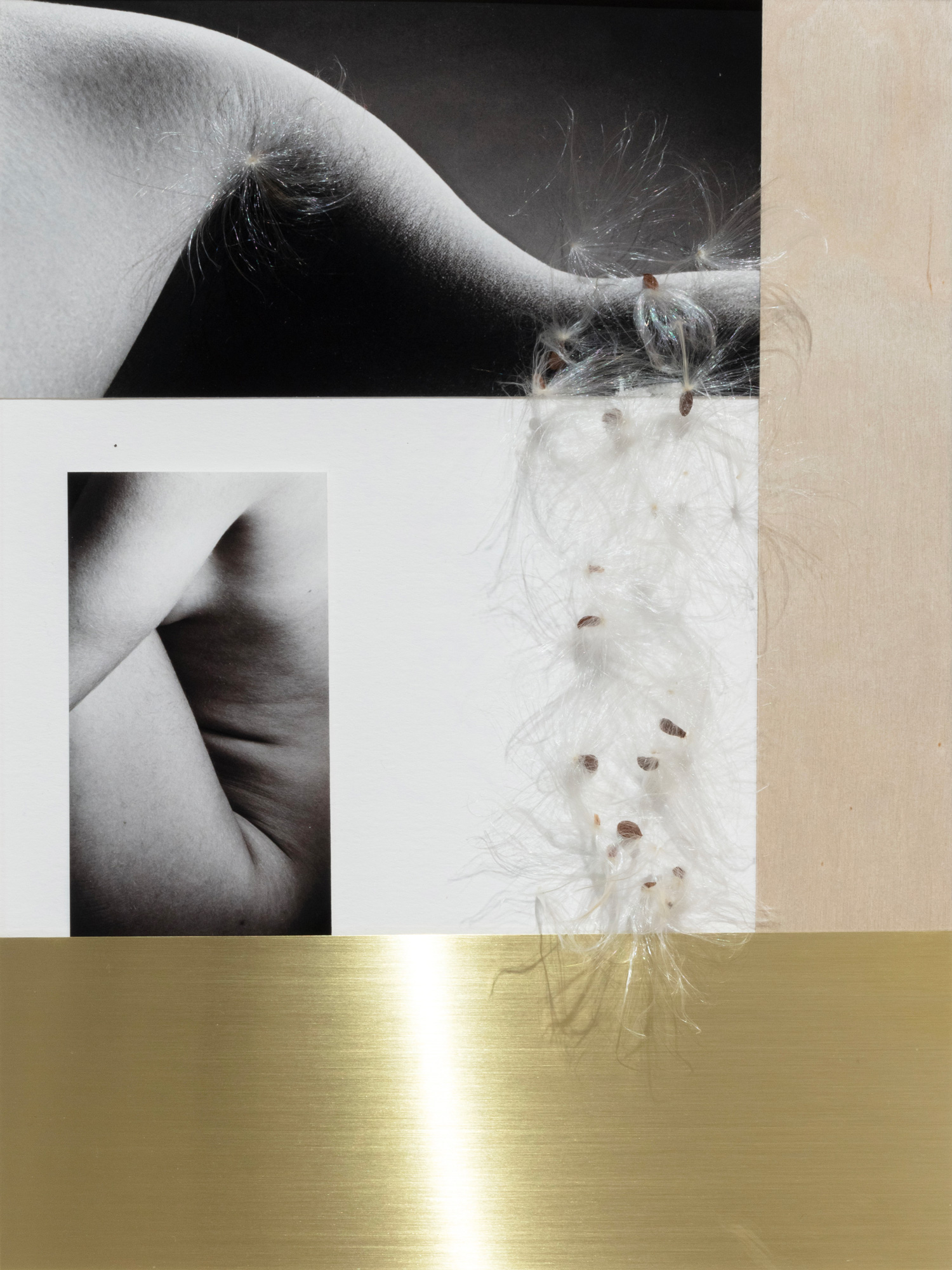
Photo collage
Photo collage/drawing, wood, Bronze, Copper, Dried plant, Acrylic box